
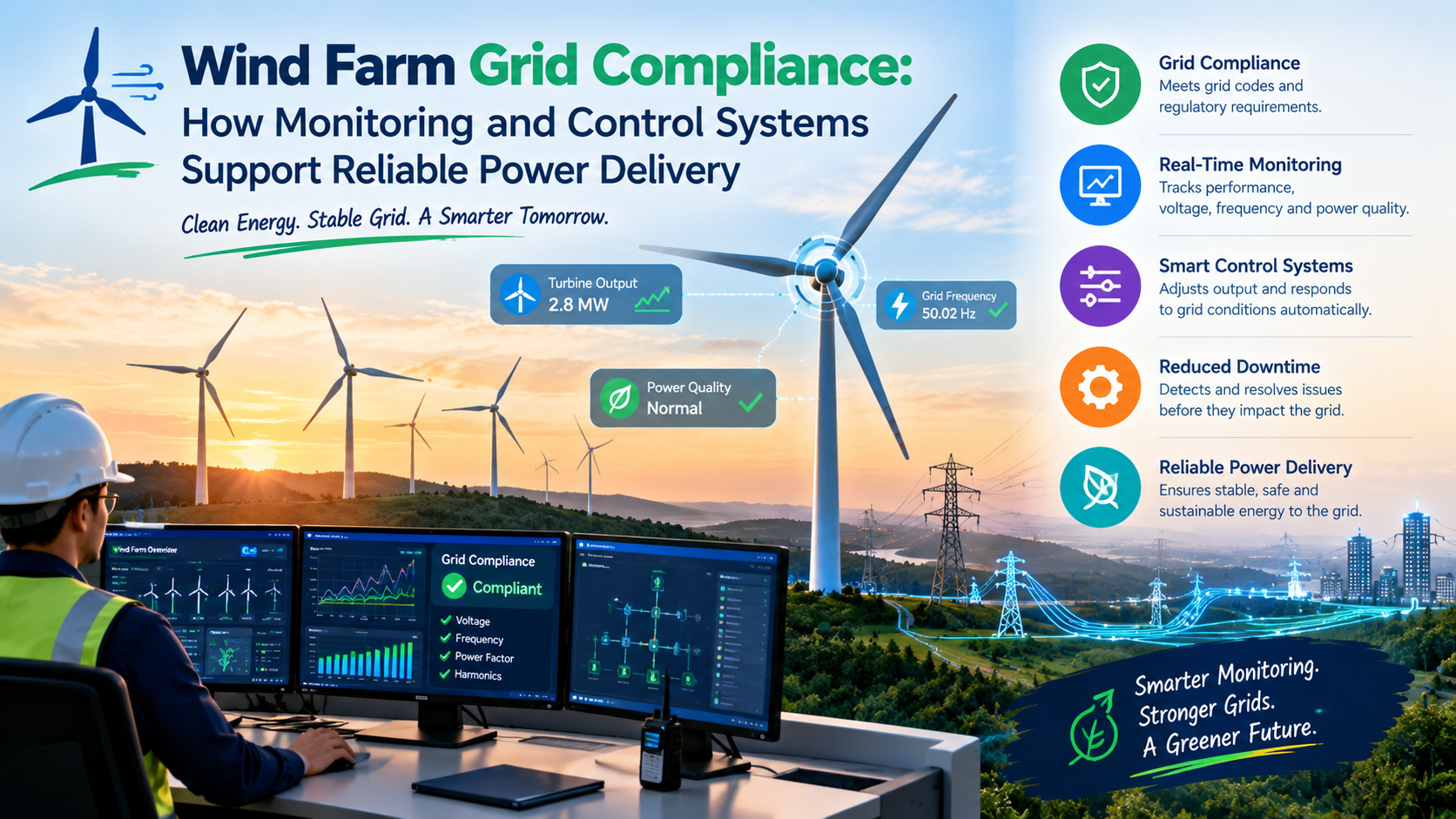
India’s renewable energy sector is growing fast. Wind capacity alone has crossed 46 GW, and the push toward 500 GW of non-fossil capacity by 2030 means grid operators are tightening the rules. For wind farm owners, operators, and EPC companies, wind farm grid compliance is no longer a one-time certification exercise. It is an ongoing operational requirement that decides whether a plant gets paid, penalized, or disconnected.
If your wind assets struggle with voltage fluctuations, frequency deviations, or fault ride-through failures, you are not alone. Many operators discover compliance gaps only after a grid disturbance event triggers a penalty notice. The good news: modern monitoring and control systems can catch these issues before they become costly problems.
In this guide, we break down what wind farm grid compliance actually involves, why it matters for reliable power delivery, and how SCADA-driven monitoring and control systems help renewable energy companies stay compliant, profitable, and grid-friendly.
What Is Wind Farm Grid Compliance?
Wind farm grid compliance refers to a wind power plant’s ability to meet the technical, operational, and regulatory standards set by grid codes, the rules that govern how generating stations connect to and interact with the electricity grid.
These requirements typically cover:
- Voltage regulation within specified limits
- Frequency response during grid disturbances
- Reactive power control and power factor management
- Fault ride-through (FRT) capability during voltage dips
- Power quality (harmonics, flicker, and voltage unbalance)
- Real-time data exchange with grid operators and load dispatch centers
In India, these standards are enforced through the Central Electricity Authority (CEA) technical standards, state grid codes, and Indian Electricity Grid Code (IEGC) regulations, with oversight from Regional and State Load Dispatch Centers.
Non-compliance isn’t just a paperwork issue. It can mean curtailed generation, financial penalties, or in severe cases, disconnection from the grid.
Why Wind Power Grid Compliance Is Getting Harder
A decade ago, wind power grid compliance was largely about meeting connection standards once, during commissioning. That has changed for three reasons:
1. Higher renewable penetration means tighter grid codes
As wind energy contributes more to the generation mix, grid operators depend on these plants to actively support grid stability , not just feed in power. This has pushed grid codes toward dynamic compliance requirements, like real-time reactive power support and frequency response.
2. Grid disturbances are more frequent
With more variable generation sources online, voltage sags, frequency swings, and short-duration faults happen more often. Wind turbines must now ride through these events without tripping offline, a requirement known as fault ride-through.
3. Regulators are moving toward continuous monitoring
Many load dispatch centers now require real-time data feeds from wind farms rather than periodic compliance reports. This shift from static certification to continuous grid compliance for renewable energy assets is exactly where monitoring and control technology becomes essential.
Key Components of Wind Farm Grid Integration
Successful wind farm grid integration depends on multiple systems working together. Here’s what forms the backbone of a compliant, reliable wind power plant.
1. Wind Turbine Monitoring Systems
Wind turbine monitoring systems continuously track parameters like rotor speed, blade pitch, generator output, nacelle vibration, and grid-side electrical values, often via a CE-certified measurement panel. This data feeds into compliance reporting and helps operators spot early signs of underperformance or mechanical stress , often before a fault occurs.
2. Wind Farm SCADA Systems
A wind farm SCADA system (Supervisory Control and Data Acquisition) is the central nervous system of the plant. It collects data from every turbine, substation, and met mast in real time, allowing operators to:
- Monitor plant-wide performance from a single dashboard
- Detect anomalies instantly
- Issue remote control commands
- Generate compliance-ready reports for regulators
Smaller sites or retrofit projects can also deploy a compact SCADA setup where a full-scale installation isn’t practical. Without a robust SCADA layer, achieving consistent grid code compliance for wind farms across dozens or hundreds of turbines becomes nearly impossible.
3. Wind Farm Control Systems
While monitoring tells you what’s happening, wind farm control systems determine the response. At the substation level, a Power Plant Controller (PPC) coordinates plant-wide active and reactive power output to meet grid operator instructions in real time. These systems manage:
- Reactive power control to maintain voltage stability
- Active power curtailment during grid instructions
- Frequency control to match grid demand
- Coordinated turbine shutdown/restart sequences
Together, monitoring and control form a closed loop, see the problem, respond to the problem, and prove the response to the regulator.
Core Technical Requirements for Grid Code Compliance
Let’s look at the specific technical areas every wind farm operator needs to manage for grid compliance.
Wind Farm Voltage Regulation
Grid codes require wind farms to maintain voltage within a defined band at the point of common coupling. Voltage regulation systems automatically adjust reactive power output to counter voltage swings caused by changing wind speeds or grid load.
Practical insight: A plant without automated voltage regulation often sees manual intervention delays of several minutes during a voltage event, enough time to trigger a compliance violation. Automated control systems respond in seconds.
Wind Farm Reactive Power Control
Reactive power control allows a wind farm to either absorb or supply reactive power as instructed by the grid operator, helping stabilize voltage across the transmission network. Most Indian grid codes mandate a specific power factor range (commonly 0.95 lagging to 0.95 leading) at the interconnection point.
Wind Turbine Frequency Control
When grid frequency drops below the nominal band (49.5–50.05 Hz in India, per IEGC norms), compliant wind farms must respond by adjusting active power output, either increasing generation (if headroom exists) or reducing it to support frequency recovery.
Wind Power Fault Ride-Through Compliance
Fault ride-through compliance requires turbines to stay connected to the grid during short-duration voltage dips caused by faults elsewhere on the network, rather than tripping offline. Losing even a few hundred MW of wind generation during a grid fault can cascade into larger stability problems, which is why FRT compliance is now a mandatory certification requirement for new wind projects in India. Our case study on substation design for wind integration looks at how precise substation engineering supports this kind of grid reliability.
Wind Farm Power Quality Monitoring
Power quality monitoring tracks harmonics, voltage flicker, and unbalance, issues that, left unmanaged, can damage grid equipment and trigger penalties. Continuous monitoring allows operators to catch quality degradation (such as a failing transformer or inverter fault) before it escalates.
How Monitoring and Control Systems Solve Renewable Energy Grid Integration Challenges
Renewable energy grid integration challenges are not unique to wind, solar plants face similar issues, but wind’s variability makes real-time response critical. Here’s how an integrated monitoring and control approach addresses the biggest pain points:
| Challenge | How Monitoring & Control Helps |
|---|---|
| Delayed fault detection | Real-time alarms flag deviations within seconds |
| Manual compliance reporting | Automated, audit-ready reports reduce human error |
| Inconsistent voltage/frequency response | Closed-loop automation reacts faster than manual ops |
| Scattered turbine-level data | Centralized SCADA gives plant-wide visibility |
| Limited visibility for O&M teams | Remote monitoring enables proactive maintenance |
Wind Farm Remote Monitoring: A Game-Changer for O&M Teams
For O&M companies managing assets across multiple sites, wind farm remote monitoring removes the need for constant on-site presence. A centralized wind energy management system, backed by IoT-enabled services, lets teams:
- View live performance data from any location
- Set custom alerts for compliance thresholds
- Track wind turbine performance monitoring metrics like capacity factor and availability
- Coordinate faster response during grid events
This is particularly valuable for plants spread across remote wind corridors in states like Tamil Nadu, Gujarat, Karnataka, and Rajasthan, where travel time to site can delay compliance response by hours. One of our case studies on enhancing manpower safety through individual wind turbine operation shows how remote control capability also reduces the need for on-site manual intervention.
Step-by-Step: Building a Compliant Wind Farm Monitoring & Control Setup
- Audit existing infrastructure — Identify gaps in current monitoring coverage, communication protocols, and control response times.
- Deploy real-time wind power monitoring at the turbine and substation level — Ensure data capture covers voltage, frequency, reactive power, and fault events.
- Integrate a centralized SCADA platform — Consolidate turbine, substation, and met mast data into one system.
- Implement automated control logic — Program response protocols for voltage regulation, frequency support, and FRT scenarios.
- Enable wind farm grid synchronization checks — Validate that reconnection after a fault or maintenance event meets synchronization standards (voltage, frequency, and phase angle matching).
- Set up compliance reporting automation — Generate the data formats required by your regional load dispatch center without manual compilation.
- Review and recalibrate regularly — Grid codes evolve; your control logic should too.
Why Electrical Protection Systems Matter for Compliance
Wind farm electrical protection systems safeguard both the plant and the grid from damage during fault conditions. Relay panels and busbar panels, alongside automated isolation systems, must be correctly coordinated with control logic, if protection trips too early, it can cause unnecessary disconnections that look like non-compliance events on regulator records.
This is why wind farm automation and control design should treat protection and compliance as linked systems, not separate workstreams.
The Business Case: Why Compliance Monitoring Pays for Itself
Beyond avoiding penalties, strong grid compliance monitoring delivers measurable returns:
- Fewer curtailment losses from faster fault response
- Higher availability through early fault detection via wind turbine performance monitoring
- Lower O&M travel costs with remote, centralized visibility
- Stronger PPA relationships by consistently meeting delivery and quality obligations
- Audit-ready documentation that simplifies regulatory inspections
For a 50 MW wind farm, even a single avoided grid disconnection event, which can mean hours of lost generation plus regulatory scrutiny, often justifies the investment in a proper monitoring and control upgrade.
Why GEISPL Is the Right Partner for Wind Farm Grid Compliance
GEISPL, based in Bangalore, specializes in SCADA and Central Monitoring System (CMS) integration built specifically for renewable energy assets, wind, solar, and hybrid plants. For wind farm owners and operators navigating evolving grid codes, GEISPL brings:
- Deep experience integrating wind turbine monitoring systems and substation automation into unified SCADA platforms
- Control system design aligned with Indian grid code requirements, voltage regulation, reactive power control, and fault ride-through compliance
- Remote monitoring solutions built for O&M companies managing multi-site portfolios
- A proven approach: SEE. CONTROL. PREDICT. CONNECT. PROTECT., covering real-time visibility, automated control response, predictive maintenance insight, connected data reporting, and electrical protection coordination
Whether you’re an EPC company commissioning a new wind project or an operator retrofitting an existing plant for tighter compliance, GEISPL’s SCADA and CMS solutions are built to keep your assets compliant and your power delivery reliable.
Want to see how a compliant monitoring and control setup could work for your wind farm? Get in touch with GEISPL’s team to discuss your project.
FAQs
1. What is wind farm grid compliance?
Wind farm grid compliance means meeting the technical and regulatory standards, voltage, frequency, reactive power, and fault ride-through requirements, set by grid codes for connecting and operating a wind power plant on the electricity grid.
2. Why do wind farms need SCADA systems for compliance?
SCADA systems give operators real-time visibility into every turbine and substation, enabling fast fault detection, automated control response, and accurate compliance reporting to grid authorities, tasks that are nearly impossible to manage manually at scale.
3. What is fault ride-through (FRT) in wind power?
Fault ride-through is a turbine’s ability to stay connected to the grid during a short-duration voltage dip caused by a fault, instead of disconnecting. It’s a mandatory requirement in most modern grid codes, including India’s.
4. How does reactive power control help with grid compliance?
Reactive power control allows a wind farm to adjust its power factor to help stabilize grid voltage, which is a standard requirement at most interconnection points under Indian grid codes.
5. Can remote monitoring really reduce compliance risk?
Yes. Remote monitoring gives O&M teams real-time alerts and data access regardless of location, cutting response time during grid events and reducing the chance of a compliance violation going unnoticed.
6. How often do wind farm grid codes change?
Grid codes are reviewed periodically by regulators like the CEA and CERC, especially as renewable penetration increases. Operators should review their compliance setup at least annually, or whenever new regulations are notified.
GEISPL
D38, 4th A Main Road, Rajajinagar Industrial Estate, Bangalore – 560010
???? 080-4160-1403 | ???? reachus@geispl.in
Get Directions | Contact Us
Category: SCADA