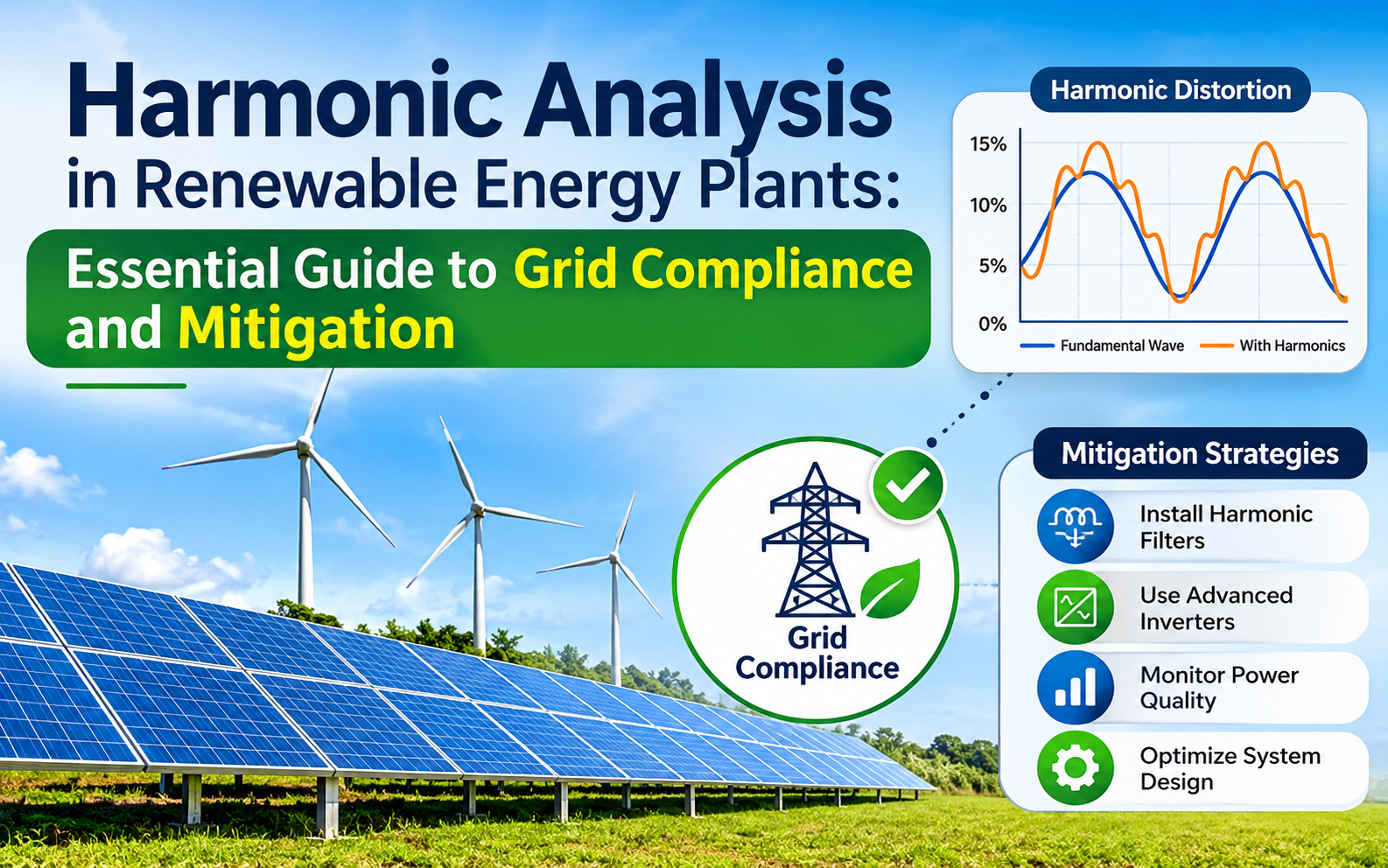
Renewable energy is transforming India's power sector, with solar and wind farms playing an important role in electricity generation. However, connecting renewable energy systems to the electrical grid creates challenges related to voltage stability, power quality, and electrical safety. One of the most important challenges is harmonic distortion.
Harmonic analysis in renewable energy plants helps identify electrical disturbances caused by inverters, converters, transformers, and other power electronic equipment. If harmonics are not properly controlled, they can affect grid stability, increase equipment losses, cause overheating, and create compliance issues for renewable energy projects.
For solar plant owners, wind farm operators, EPC contractors, and O&M companies, understanding harmonics is essential for maintaining reliable electricity generation.
In this guide, we explain harmonic distortion, its causes, the importance of grid compliance, testing methods, and practical mitigation techniques for renewable energy plants in India.
What Is Harmonic Analysis in Renewable Energy Plants?
Harmonic analysis is the process of measuring, studying, and evaluating electrical waveforms to identify harmonic frequencies that affect power quality.
Ideally, electricity supplied through an AC power system follows a smooth sinusoidal waveform. However, equipment such as solar inverters, wind turbine converters, variable frequency drives, and switching power supplies can introduce additional frequencies into the electrical system.
These additional frequencies are called harmonics.
Harmonic analysis helps engineers determine:
- Which harmonic frequencies are present in the electrical system
- The magnitude of individual harmonic components
- Total Harmonic Distortion (THD)
- Whether harmonic levels meet applicable grid requirements
- Whether electrical equipment is exposed to excessive distortion
- Which mitigation solutions are required
In renewable energy plants, harmonic analysis is particularly important at the point where the generating facility connects to the utility grid, known as the Point of Common Coupling (PCC).
Why Harmonics Occur in Renewable Energy Plants
Renewable energy systems depend heavily on power electronic devices to convert generated electricity into grid-compatible power.
These devices perform essential functions but can also introduce harmonic currents and voltage distortion.
1. Solar Inverters
Solar photovoltaic panels generate DC electricity. Solar inverters convert this DC power into AC electricity suitable for grid connection.
During switching and power conversion, inverters may introduce harmonic components into the electrical system.
The severity depends on factors such as
- Inverter design and switching frequency
- Operating load
- Grid impedance
- Filter performance
- Number of connected inverters
- Electrical system configuration
This is one of the main causes of harmonic distortion in solar power plants.
2. Wind Turbine Power Converters
Modern wind turbines use power converters to regulate generator output and maintain grid synchronization.
These converters can contribute to harmonic emissions, particularly when multiple turbines operate simultaneously and their electrical characteristics interact with the collector network.
3. Variable Frequency Drives
VFDs are commonly used in pumps, cooling systems, motors, and industrial equipment associated with renewable energy facilities.
Their rectifier circuits can introduce harmonic currents, which may affect nearby electrical equipment.
4. Transformers and Electrical Equipment
Transformers can produce harmonic distortion due to magnetic saturation and nonlinear operating conditions.
Poor transformer sizing, improper system design, and harmonic resonance can increase electrical stress.
5. Multiple Power Electronic Devices
A large solar or wind plant may have hundreds of inverters, converters, control systems, and auxiliary electrical loads.
Even when individual equipment produces acceptable harmonic levels, the combined harmonic contribution may affect the overall plant power quality.
What Is Harmonic Distortion in Solar Power Plants?
Harmonic distortion occurs when an electrical waveform deviates from its ideal sinusoidal shape because of additional harmonic frequency components.
In solar power plants, harmonic distortion commonly originates from inverter switching, power conversion, and interactions between the inverter and the grid.
The two most commonly evaluated parameters are:
Total Harmonic Distortion (THD)
THD measures the combined contribution of harmonic components compared with the fundamental frequency.
Voltage THD (THDv) measures harmonic distortion in the voltage waveform.
Current THD (THDi) measures harmonic distortion in the current waveform.
A higher THD value indicates greater waveform distortion, although compliance evaluation must consider the applicable limits, measurement location, system conditions, and the relevant standard.
Individual Harmonic Distortion
Individual harmonic analysis evaluates specific frequencies such as the 3rd, 5th, 7th, 11th, and 13th harmonics.
This is important because a system may have acceptable overall THD but still experience excessive distortion at a particular harmonic frequency.
For example, the 5th harmonic may contribute to transformer heating, while certain harmonic frequencies can interact with capacitor banks and create resonance.
Why Harmonic Analysis in Renewable Energy Plants Is Important
Conducting harmonic studies is not only about meeting technical requirements. It also protects equipment, improves reliability, and reduces operational risks.
1. Maintaining Grid Compliance
Grid-connected renewable energy plants must comply with applicable connectivity regulations, grid codes, utility requirements, and project-specific connection agreements.
Harmonic current injection and power quality parameters must be evaluated according to the applicable standards.
In India, the CEA technical connectivity regulations for inverter-based and wind-generating stations reference IEEE 519 requirements for harmonic current injection. Relevant provisions also address DC injection and flicker.
IndiaCode+1
2. Preventing Equipment Overheating
Harmonic currents increase electrical losses in transformers, cables, motors, and other equipment.
Excessive losses can lead to:
- Higher operating temperatures
- Insulation deterioration
- Reduced equipment lifespan
- Unexpected maintenance
- Increased energy losses
3. Reducing Equipment Failure
Harmonics may affect protective relays, capacitor banks, measurement devices, and electrical control systems.
In some situations, harmonic distortion can result in nuisance tripping or incorrect equipment operation.
4. Improving Energy Generation Reliability
A renewable energy plant experiencing power quality problems may face inverter shutdowns, alarms, grid disconnection, or equipment degradation.
Proper analysis helps operators identify electrical issues before they affect generation performance.
5. Supporting Long-Term Project Performance
For solar and wind projects, even small recurring electrical problems can result in operational inefficiencies over time.
Harmonic monitoring and mitigation help maintain reliable operation and protect the long-term value of electrical infrastructure.
Grid Compliance for Renewable Energy Plants in India
Grid Compliance for Renewable Energy Plants involves meeting the electrical, operational, protection, and communication requirements established by applicable authorities and utilities.
Depending on the plant configuration, capacity, connection voltage, and agreement, requirements may cover:
- Harmonic current injection
- Voltage harmonic distortion
- Reactive power management
- Power factor control
- Voltage regulation
- Frequency response
- Fault ride-through capability
- Flicker
- DC injection
- Protection coordination
- Communication and telemetry
The Central Electricity Authority's technical connectivity regulations reference IEEE 519 for harmonic current injection requirements for generating stations using inverters and wind generating stations. Specific requirements and measurement procedures should be verified against the latest applicable regulations and project connectivity agreement.
IndiaCode+1
Why IEEE 519 Matters
IEEE 519 provides guidance and limits for harmonic distortion in power systems.
The assessment typically considers the electrical system's characteristics, including the PCC, short-circuit strength, and harmonic current levels.
Renewable energy developers should not assume a single THD limit applies to every installation. Applicable limits depend on system voltage, the standard's measurement criteria, and the relevant utility or regulatory requirements.
A professional harmonic study helps determine whether the plant's harmonic performance is acceptable before commissioning or during operation.
Power Quality Analysis in Renewable Energy: What Should Be Measured?
A comprehensive power quality analysis in renewable energy systems evaluates several electrical parameters.
| Parameter | What It Indicates |
|---|---|
| Voltage THD | Overall voltage waveform distortion |
| Current THD | Overall current waveform distortion |
| Individual harmonics | Distortion at specific harmonic frequencies |
| Voltage variation | Changes in voltage magnitude |
| Frequency | Grid frequency stability |
| Power factor | Relationship between active and reactive power |
| Flicker | Rapid voltage variations affecting electrical performance |
| Voltage imbalance | Differences between three-phase voltage magnitudes |
| Transients | Short-duration electrical disturbances |
| DC injection | DC component entering the AC grid |
Monitoring these parameters provides a complete picture of the plant's electrical performance.
For larger installations, measurements should be carried out using suitable power quality analyzers and measurement procedures that comply with applicable standards.
How Harmonic Analysis Is Conducted in Renewable Energy Plants
A systematic harmonic study helps identify the source of distortion and determine the appropriate mitigation method.
Step 1: Collect Electrical System Information
Engineers review the plant's electrical design, including:
- Single-line diagrams
- Transformer ratings and impedance
- Inverter specifications
- Cable lengths and sizes
- Capacitor bank details
- Grid connection characteristics
- Protection settings
- Existing power quality reports
This information helps understand the electrical network and potential harmonic sources.
Step 2: Conduct Power Quality Measurements
Measurements are taken at suitable locations, particularly the PCC, inverter output, transformer secondary, and other relevant points.
The study may include:
- Voltage and current measurements
- Harmonic spectrum analysis
- THD evaluation
- Load variation analysis
- Operating condition assessment
Step 3: Identify Harmonic Sources
The collected data is analyzed to identify equipment responsible for harmonic distortion.
For example, if the 5th and 7th harmonics increase when certain inverter groups operate, engineers may investigate inverter characteristics, filter performance, and network impedance.
Step 4: Evaluate Grid Compliance
The measured values are compared with the applicable grid code, IEEE standards, utility requirements, and connection agreement.
This determines whether the plant meets the required electrical performance criteria.
Step 5: Recommend Mitigation Solutions
If harmonic levels exceed acceptable limits, engineers identify suitable solutions based on the frequency spectrum, electrical network, and equipment characteristics.
Step 6: Verify the Results
After installing mitigation equipment, power quality measurements are repeated.
The final report should document the original distortion levels, corrective actions, post-mitigation measurements, and compliance assessment.
Harmonic Mitigation in Renewable Energy: Effective Solutions
Harmonic mitigation in renewable energy requires selecting the right solution for the electrical system rather than installing equipment without understanding the harmonic source.
1. Passive Harmonic Filters
Passive filters use combinations of inductors, capacitors, and resistors to reduce selected harmonic frequencies.
They are commonly used to target specific harmonic components.
Benefits include:
- Relatively simple design
- Cost-effective solutions for selected applications
- Reduction of targeted harmonic currents
- Potential improvement in power factor
However, passive filters must be carefully designed because changes in grid impedance may affect their performance.
2. Active Harmonic Filters
Active harmonic filters detect harmonic components and inject compensating currents to reduce distortion.
They can address multiple harmonic frequencies and changing electrical conditions.
Active filters may be suitable where:
- Harmonic levels vary with plant operation
- Multiple nonlinear loads are present
- A wide range of harmonic frequencies needs mitigation
- The electrical system requires dynamic compensation
3. Inverter Configuration and Optimization
Modern inverters often include advanced power quality control features.
Correct inverter selection, configuration, firmware settings, and commissioning can improve harmonic performance.
Plant operators should review manufacturer specifications and ensure that inverter operating conditions align with the project's electrical requirements.
4. Transformer and Cable Design
Proper transformer selection, cable sizing, grounding, and electrical network design can reduce harmonic-related stress.
Engineers should consider harmonic loading while designing electrical infrastructure rather than treating it as an issue only after commissioning.
5. Power Plant Controller Integration
A Power Plant Controller (PPC) manages plant-level electrical parameters such as active power, reactive power, voltage, and power factor.
Although a PPC is not itself a dedicated harmonic filter, proper plant control and integration can support overall grid performance and compliance management.
Explore GEISPL's Power Plant Controller solutions for renewable energy applications involving grid integration and plant-level control.
Real-World Example: Harmonic Issues in a Solar Power Plant
Consider a 50 MW solar power plant with multiple inverter blocks connected to a common transformer and grid connection point.
During commissioning, the plant experiences higher-than-expected harmonic current injection at the PCC.
The plant owner initially suspects a faulty inverter.
However, harmonic measurements reveal that the distortion increases under specific operating conditions when multiple inverter groups operate together.
A detailed investigation identifies the following contributing factors:
- Inverter harmonic contributions
- Network impedance at the PCC
- Interaction with existing capacitor banks
- Electrical system resonance at selected frequencies
The engineering team performs a harmonic study, evaluates filter options, and recommends corrective measures.
After implementing the solution, the team conducts follow-up measurements to verify improvement.
The key lesson: Harmonic problems cannot always be solved by replacing individual inverters. The entire electrical network must be evaluated to identify interactions between equipment and the grid.
How SCADA and Monitoring Systems Help Manage Power Quality
Continuous monitoring helps renewable energy operators identify changes in electrical performance.
SCADA systems provide visibility into important plant parameters, alarms, equipment status, and operating conditions.
When integrated with suitable power quality monitoring devices, plant operators can:
- Monitor electrical parameters remotely
- Identify abnormal operating conditions
- Review alarms and trends
- Compare performance across inverter blocks
- Support troubleshooting
- Improve maintenance planning
GEISPL provides renewable energy monitoring and control solutions for wind and solar applications.
Explore:
For renewable energy operators managing multiple sites, monitoring and control systems can support faster fault identification and more informed maintenance decisions.
Harmonic Analysis Checklist for Renewable Energy Plant Owners
Before commissioning a solar or wind power plant, EPC companies and plant owners should consider the following checklist.
Electrical Power Quality Checklist
- Review inverter and converter harmonic specifications.
- Verify transformer ratings and impedance.
- Review the electrical single-line diagram.
- Identify harmonic-producing equipment.
- Conduct harmonic measurements at the PCC.
- Measure individual harmonics and THD.
- Evaluate capacitor bank and resonance risks.
- Check applicable CEA, IEEE, IEC and utility requirements.
- Assess the need for harmonic filters.
- Verify mitigation performance after installation.
- Maintain power quality reports and measurement records.
- Review monitoring and maintenance requirements.
This checklist can help EPC contractors, commissioning engineers, and renewable energy O&M teams identify potential power quality issues early.
Common Mistakes to Avoid During Harmonic Analysis
Many renewable energy projects face avoidable power quality issues because harmonic studies are conducted too late or without considering the complete electrical network.
Mistake 1: Checking Only Inverter Harmonics
Individual inverter performance does not necessarily represent the entire plant's harmonic performance.
Measurements should consider the combined operation of the plant and its connection to the grid.
Mistake 2: Ignoring Grid Impedance
Harmonic behavior depends on the electrical network.
Changes in grid impedance can affect harmonic levels and may create resonance conditions.
Mistake 3: Installing Filters Without a Study
Installing a filter without proper engineering analysis may not solve the problem. In certain configurations, filters can create unwanted resonance or amplify harmonic components.
Mistake 4: Conducting Measurements Only During Commissioning
Electrical conditions change over time because of equipment aging, network modifications, operating conditions, and changes in grid characteristics.
Periodic assessment helps identify emerging issues.
Mistake 5: Ignoring Monitoring and Maintenance
Power quality should form part of the plant's ongoing electrical maintenance strategy.
Monitoring data, alarm trends, inspection records, and periodic testing help maintain consistent performance.
Why Choose GEISPL for Renewable Energy Engineering Solutions?
Gigahertz Engineering & Industrial Services (GEISPL) is a Bangalore-based engineering organization working in renewable energy, industrial automation, wind, solar, and hybrid energy solutions.
The website highlights experience across renewable energy applications, monitoring and control systems, manufacturing, and engineering solutions.
Its renewable energy capabilities include:
- Wind energy monitoring and control
- Solar energy solutions
- Hybrid power plant integration
- SCADA and monitoring systems
- Power Plant Controllers
- Industrial automation
- Asset management
- Electrical system support and maintenance
Relevant GEISPL Resources and Services
For renewable energy companies researching harmonic analysis and grid compliance, the following website resources are relevant:
1. Power Plant Controller Solutions
Explore Power Plant Controllers
Learn about plant-level control of active power, reactive power, voltage, and grid integration.
2. Wind Energy Solutions
Understand wind turbine monitoring, control room solutions, WTG control, and grid monitoring applications.
3. Solar Energy Solutions
Explore Solar Energy Solutions
Discover solar system integration, monitoring, maintenance, and renewable energy control applications.
4. Asset Management
Explore Asset Management Services
Learn how systematic monitoring, maintenance, performance improvement, and risk management help optimize renewable energy assets.
5. Renewable Energy and Grid Compliance Blogs
Read GEISPL Renewable Energy Blogs
Explore additional information about renewable energy operations, power plant controllers, SCADA, grid compliance, and maintenance.
Why Is GEISPL.in Important for This Topic?
GEISPL's website is relevant to harmonic analysis because it focuses on engineering solutions for the same infrastructure where power quality and grid integration challenges occur.
The company works in wind, solar, and hybrid energy applications and provides solutions related to monitoring, control, plant integration, and electrical engineering.
For renewable energy plant owners, this creates a relevant connection between harmonic analysis and practical operational requirements.
Harmonic analysis is not an isolated electrical study. Its findings may influence inverter performance, transformer selection, electrical system design, monitoring requirements, maintenance planning, and grid connectivity.
GEISPL's renewable energy engineering expertise, power plant controller solutions, wind and solar systems, and monitoring capabilities make its website a useful resource for businesses researching renewable energy system reliability and grid integration.
However, harmonic analysis, harmonic filter design, and harmonic compliance testing should be confirmed directly with the engineering team based on the specific project requirements before presenting them as a contracted service.
Conclusion
Harmonic Analysis in Renewable Energy Plants is essential for maintaining power quality, protecting electrical equipment, and ensuring reliable grid integration.
Solar inverters, wind turbine converters, transformers, and other nonlinear equipment can introduce harmonic distortion that affects the performance of renewable energy facilities.
Through systematic power quality analysis, engineers can identify harmonic sources, evaluate compliance, and implement suitable mitigation solutions such as passive filters, active filters, improved electrical design, and appropriate monitoring systems.
For renewable energy companies, wind farm owners, solar plant operators, EPC contractors, and O&M teams, proactive harmonic management can reduce operational risks and support long-term plant reliability.
As renewable energy capacity continues to expand across India, maintaining power quality and grid compliance will remain an important part of successful project development and operation.
If your renewable energy project requires engineering support for grid integration, monitoring, plant control, or electrical system optimization, connect with Gigahertz Engineering & Industrial Services (GEISPL) to discuss your project requirements.
Frequently Asked Questions (FAQs)
1. What is harmonic analysis in renewable energy plants?
Harmonic analysis is the process of measuring and evaluating harmonic frequencies in electrical systems. It helps identify waveform distortion caused by inverters, converters, and other nonlinear equipment, ensuring power quality and grid compliance.
2. What causes harmonic distortion in solar power plants?
Harmonic distortion in solar power plants is mainly caused by solar inverters, switching devices, power converters, transformers, and nonlinear electrical loads. The level of distortion depends on equipment characteristics and the electrical network.
3. Why is harmonic mitigation important in renewable energy?
Harmonic mitigation reduces waveform distortion, prevents equipment overheating, improves power quality, protects electrical infrastructure, and supports compliance with applicable grid connectivity requirements.
4. Which standards apply to harmonic analysis in renewable energy plants in India?
Applicable requirements may include CEA connectivity regulations, IEEE 519, IEC power quality standards, utility requirements, and project-specific grid connectivity agreements. The exact limits and measurement criteria depend on the installation and applicable regulations.
5. How can harmonic distortion be reduced in solar and wind power plants?
Harmonic distortion can be reduced using passive harmonic filters, active harmonic filters, suitable inverter selection, improved electrical system design, and proper commissioning. A harmonic study should determine the most suitable solution.
6. When should harmonic analysis be conducted in a renewable energy plant?
Harmonic analysis should be considered during electrical design, commissioning, grid connectivity assessment, troubleshooting, and periodic power quality monitoring. It may also be required by the applicable regulations or utility connection agreement.
Contact GEISPL for Renewable Energy Engineering Solutions.
- Website: https://geispl.in/
- Office: 080-4160-1403
- Email: reachus@geispl.in
- Address: D38, 4th A Main Road, Rajajinagar Industrial Estate, Bangalore – 560010
Category: SCADA